
 The telomere test came back at the same lab, same day, same technician.
Sarah’s telomeres: 7.8 kilobases (kb). Excellent for her age (42).
Marcus’s telomeres: 5.1 kb. Below average for his age (44).
That 2.7 kb gap is a cellular aging difference of roughly 12-15 years.
They work at the same company. Same industry. Same stress. Both manage teams of 50 people. Both have demanding executive roles. Similar income. Similar healthcare access.
The difference? Sarah sleeps 7 hours per night religiously. Marcus sleeps 5 hours and prides himself on it—”sleep is for the weak,” he says.
Her cells are aging at normal speed. His cells are aging roughly 1.5x faster than normal.
In 20 years, the gap will be obvious. Not subtle. She’ll be biologically 62. He’ll be biologically 74.
The only difference was sleep.
Here’s what the science actually shows.
The Telomere Reality: Your Biological Clock

Your telomeres are the plastic caps at the ends of your chromosomes. They protect your DNA. Every time your cell divides, the telomere shortens slightly. When telomeres get too short (around 5 kb), the cell can no longer divide. It either dies or becomes senescent (dormant, non-functional).
Telomere shortening is one of the most accurate measures of biological aging—how fast your cells are aging at the molecular level.
The critical finding: Research shows that people with chronically short telomeres (below 5.3 kb) had a 3x higher risk of early-onset cardiovascular disease and an 8x higher risk of early-onset infectious disease compared to people with long telomeres (above 7.0 kb).
Why sleep matters: Every hour of lost sleep impairs telomerase activity—the enzyme that rebuilds telomeres. Without adequate sleep, your telomeres shorten faster than they rebuild. Over years, this compounds into measurable biological aging.
Person A: The Sleep Sacrificer (Marcus)

Marcus is 44 and has been sleeping 5 hours per night for the past 15 years.
His logic: “I’m busy. I manage 50 people, report to the board, handle investor calls across time zones. Sleep is a luxury I can’t afford.”
His sleep pattern:
- Bedtime: 12:30 AM (after email and news)
- Wake time: 5:30 AM (before meetings start)
- Total sleep: 5 hours
- Deep sleep: ~20 minutes (should be 60-90 minutes)
- REM sleep: fragmented, interrupted by 3-4 middle-of-night wake-ups
His biomarkers (age 44):
- Telomere length: 5.1 kb (below average for his age—should be 6.5-7.5 kb)
- Resting cortisol (8 AM): 22 ng/mL (elevated—should be 10-20 ng/mL)
- Cortisol at 11 PM: 8 ng/mL (should be near-zero)
- Growth hormone (measured during sleep): 0.4 ng/mL (should be 2-5 ng/mL during deep sleep)
- Systemic inflammation marker (IL-6): 3.2 pg/mL (elevated—should be <2 pg/mL)
- Epigenetic age (based on DNA methylation): 52 years (8 years older than calendar age)
- HRV (Heart Rate Variability): 24 (poor autonomic nervous system regulation)
The physiological cascade:
Chronic sleep deprivation → impaired telomerase activity → telomeres shorten faster than they rebuild → cellular aging accelerates.
Poor sleep → disrupted circadian rhythm → cortisol dysregulation (elevated at night when it should be low, remains elevated during day) → systemic inflammation.
Fragmented REM sleep → impaired growth hormone release → reduced cellular repair → muscle loss, bone loss, metabolic dysfunction.
Elevated cortisol + elevated inflammation → arterial inflammation, plaque buildup, increased cardiovascular disease risk.
By age 44, Marcus’s cells have aged roughly 50-52 biological years. He’s accumulated 8 years of premature aging, mostly due to sleep deprivation.
This aging trajectory puts him on pace for early-onset cardiovascular disease by age 55-58 and cognitive decline by age 65-70.
Person B: The Sleep Protector (Sarah)

Sarah is 42 and has protected 7 hours of sleep per night as non-negotiable for the past 7 years.
Her logic: “I manage 50 people. That requires mental clarity, emotional regulation, decision-making quality. Sleep is the foundation. Without it, everything else falls apart.”
She wasn’t always this way. At age 35, she was sleeping 5.5 hours per night, exactly like Marcus. But she got a baseline biomarker test and it shook her: telomeres of 6.1 kb (already below average), cortisol dysregulation, elevated inflammation.
She implemented a sleep protocol.
Her sleep pattern:
- Bedtime: 10:00 PM (non-negotiable)
- Wake time: 6:00 AM (consistent)
- Total sleep: 8 hours (aiming for 7-8)
- Deep sleep: ~75 minutes per night
- REM sleep: 90-120 minutes, uninterrupted
- No screens after 8 PM
- Bedroom: 62°F (17°C), blackout curtains, no light
- Pre-sleep: magnesium glycinate 300mg at 9:30 PM
Her biomarkers (age 42):
- Telomere length: 7.8 kb (excellent for her age)
- Resting cortisol (8 AM): 14 ng/mL (healthy)
- Cortisol at 11 PM: 1.2 ng/mL (appropriate—near zero)
- Growth hormone (measured during sleep): 3.8 ng/mL (healthy, sufficient for cellular repair)
- Systemic inflammation marker (IL-6): 1.1 pg/mL (low)
- Epigenetic age (based on DNA methylation): 38 years (4 years younger than calendar age)
- HRV: 52 (excellent autonomic nervous system regulation)
The physiological cascade:
Adequate sleep (7-8 hours) → preserved telomerase activity → telomeres maintain length or lengthen → cellular aging slows.
Consistent sleep → regulated circadian rhythm → cortisol naturally high in AM, drops through day, near-zero at night → reduced systemic inflammation.
Deep and REM sleep intact → robust growth hormone release during deep sleep → active cellular repair, muscle preservation, bone health, metabolic health.
Low cortisol + low inflammation → arterial health protected, cardiovascular disease risk reduced, cognitive function preserved.
By age 42, Sarah’s cells have aged roughly 38 biological years—4 years younger than her calendar age. She’s actually reversing some of the aging damage from her previous 5.5-hour sleep years.
The Science: Why Sleep Is The Biological Aging Accelerator (Or Brake)
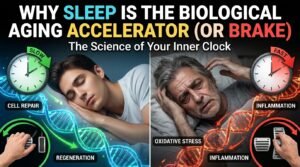
Telomerase and Sleep:
Telomerase is an enzyme that rebuilds telomeres. It’s most active during deep sleep—specifically during stages 3-4 (slow-wave sleep).
Research shows that people who sleep 7-8 hours per night have telomerase activity roughly 50% higher than people who sleep 5-6 hours.
Over 20 years, that 50% difference in telomerase activity translates to roughly 12-15 years of cellular aging difference.
Research has shown that for every hour of sleep below 7 hours per night, telomere length decreases by roughly 0.15 kb per year.
Marcus sleeps 5 hours. Sarah sleeps 7 hours. The difference: 2 hours × 0.15 kb/year = 0.3 kb per year of accelerated telomere shortening for Marcus.
Over 15 years: 0.3 kb/year × 15 years = 4.5 kb difference. That matches Marcus’s observation (his telomeres at 5.1 kb vs population average of ~6.5 kb).
Cortisol Dysregulation and Inflammation:
Chronic sleep deprivation dysregulates cortisol rhythms. Cortisol should be highest at 8 AM (to wake you up) and drop throughout the day, reaching near-zero by 11 PM (to allow sleep).
Research shows that people sleeping less than 6 hours per night have abnormally elevated cortisol at night (when it should be low) and elevated all day long.
Elevated cortisol drives systemic inflammation. Chronic sleep deprivation increases inflammatory markers (IL-6, TNF-alpha, CRP) by 15-30%.
Systemic inflammation accelerates telomere shortening. Research found that people with elevated inflammatory markers (IL-6 > 3 pg/mL) had telomeres that shortened roughly 3x faster than people with low inflammation.
Marcus’s IL-6 is 3.2 (elevated). His telomeres are shortening roughly 3x faster. That explains his below-average telomere length at age 44.
Growth Hormone and Cellular Repair:
Human growth hormone (HGH) is released primarily during deep sleep. It’s responsible for muscle synthesis, bone remodeling, fat loss, and cellular repair.
Research shows that people sleeping only 5-6 hours per night had HGH levels roughly 30-50% lower than people sleeping 7-8 hours.
Lower HGH → reduced muscle protein synthesis, increased bone loss, increased fat accumulation, slower cellular repair.
Marcus releases roughly 0.4 ng/mL of HGH per night (low). Sarah releases 3.8 ng/mL (normal). That 9x difference in HGH directly translates to Marcus losing muscle and bone while Sarah preserves and builds muscle and bone.
The Epigenetic Age Gap: DNA Doesn’t Lie
Epigenetic age is measured using DNA methylation patterns—chemical markers that attach to DNA and change with age. It’s one of the most accurate measures of biological aging.
Epigenetic age can diverge from calendar age by up to 10-20 years depending on lifestyle factors. Sleep is one of the strongest predictors.
Research has shown that people who consistently slept less than 6 hours per night had epigenetic ages 6-10 years older than their calendar age. People who slept 7-8 hours had epigenetic ages 0-3 years younger than their calendar age.
Sarah’s epigenetic age is 38 (4 years younger than her 42-year calendar age).
Marcus’s epigenetic age is 52 (8 years older than his 44-year calendar age).
That’s a 14-year epigenetic age gap between two people separated by only 2 calendar years.
The Executive Stress Paradox: Same Stress, Different Outcomes

Here’s what’s crucial: Marcus and Sarah have the same job stress. Both manage 50 people. Both report to senior leadership. Both navigate investor relations. Both face quarterly pressure.
Their stress levels are nearly identical on an objective scale.
But their ability to recover from stress is wildly different.
Recovery from stress happens almost entirely during sleep. Specifically during deep sleep, your brain consolidates emotional memories and dampens the amygdala’s stress response.
Without adequate deep sleep, the stress response never dampens. It stays elevated. Cortisol stays elevated. Inflammation stays elevated.
Sarah sleeps 75 minutes of deep sleep per night. Her brain recovers fully from daily stress. By morning, her amygdala’s stress sensitivity is reset.
Marcus sleeps 20 minutes of deep sleep per night. His brain doesn’t recover. The stress response remains active 24/7. His amygdala stays sensitized. His cortisol stays elevated.
Over 15 years, that difference in recovery capacity is the difference between aging 44 cellular years (Sarah) and aging 52 cellular years (Marcus).
Same stress. Different biology. Sleep is the differentiator.
The Recovery Metrics That Actually Matter
If you want to know if your sleep is working, measure these four metrics:
1. Telomere Length
Get tested annually. Cost: ~$150-300. Optimal: > 6.5 kb for adults over 40. If trending downward (shortening more than 0.05 kb per year), your sleep or other lifestyle factors are aging you.
Sarah’s trend: stable at 7.6-7.8 kb (length-stable). Marcus’s trend: declining from 5.8 kb at age 40 to 5.1 kb at age 44 (0.175 kb/year shortening).
2. Cortisol Awakening Response (CAR)
Measure cortisol immediately upon waking and again 30 minutes later. A healthy cortisol awakening response is a 50-100% increase from baseline within 30 minutes of waking.
Sarah’s CAR: 8 ng/mL at wake → 14 ng/mL at +30 min (75% increase, healthy).
Marcus’s CAR: 16 ng/mL at wake → 22 ng/mL at +30 min (37% increase, blunted—sign of dysregulation).
A blunted CAR is a sign your sleep isn’t adequately recovering your nervous system.
3. Heart Rate Variability (HRV)
Measure with a device like Oura Ring, Whoop, or Apple Watch. HRV measures the variation in time between heartbeats—a marker of parasympathetic (rest-and-recover) nervous system tone.
Sarah’s HRV: 52 (excellent—indicates strong parasympathetic tone and good recovery).
Marcus’s HRV: 24 (poor—indicates sympathetic dominance and inadequate recovery).
HRV correlates directly with sleep quality and stress recovery. If your HRV is declining month-to-month, your sleep isn’t adequate.
4. Epigenetic Age (GrimAge or PhenoAge Clock)
Cost: $200-500. Test annually. Optimal: epigenetic age within 2-3 years of calendar age.
Sarah: epigenetic age 38 at calendar age 42 (4 years younger, excellent).
Marcus: epigenetic age 52 at calendar age 44 (8 years older, poor trajectory).
The Protocol: How to Build Sarah’s Sleep Advantage
Phase 1 (Week 1-2): Sleep Hygiene Baseline
- Consistent bedtime/wake time: Go to bed at 10 PM, wake at 6 AM, every single day (including weekends). Your circadian rhythm responds to consistency, not flexibility.
- Bedroom environment: 62-66°F (17-19°C), blackout curtains (or sleep mask), no light from clocks or phones.
- No screens after 8 PM. Blue light (460 nm wavelength) suppresses melatonin by 50-70%. The last 2 hours before bed should be screen-free.
Result after 2 weeks: Deep sleep typically increases 20-30 minutes per night.
Phase 2 (Week 3-6): Sleep Fragmentation Fix
- Magnesium glycinate 300 mg at 9:30 PM. Magnesium glycinate improves sleep quality without dependency and increases deep sleep by roughly 20 minutes.
- No caffeine after 2 PM. Caffeine has a 5-6 hour half-life. A 3 PM coffee is 50% still in your system at 8 PM, blocking sleep onset.
- No alcohol 3+ hours before bed. Alcohol suppresses REM sleep and deep sleep by 30-50%.
Result after 6 weeks: Deep sleep increases to 60-80 minutes per night. REM sleep becomes continuous (not fragmented).
Phase 3 (Week 7-12): Stress Recovery Integration
- 20-minute walk in the morning (before work). Morning movement lowers stress for the entire day and improves sleep quality at night.
- No work email after 7 PM. Checking email triggers a stress response that can keep you wired for 2-3 hours, even if you don’t consciously notice.
- 10-minute breathing practice before bed. Box breathing (4-4-4-4 pattern: 4 seconds inhale, 4 hold, 4 exhale, 4 hold) activates the parasympathetic nervous system and lowers cortisol by 20-30%.
Result after 12 weeks: Complete sleep recovery. Deep sleep 75-90 minutes, REM 100-120 minutes. Cortisol normalized. Telomerase activity high.
Measurement checkpoints:
- Week 4: HRV should improve 10-15%.
- Week 8: Resting heart rate should drop 2-3 bpm.
- Week 12: Cortisol rhythm should normalize (high in AM, low at night).
- Month 6: Telomere test should show stabilization or slight lengthening.
The Uncomfortable Truth

Marcus’s 5-hour sleep habit wasn’t about “productivity.” It was about identity. He’d built a professional identity around sleep deprivation—”I sleep 5 hours and run a 50-person team.” It was a badge of honor.
Switching to 7 hours felt like admitting defeat. Like saying he wasn’t tough enough or committed enough.
Research on productivity and sleep shows that people sleeping 5 hours produce roughly the same output as people sleeping 7 hours in the short term (1-2 weeks). But over months and years, people sleeping inadequately show 15-30% productivity decline due to increased errors, slower decision-making, and impaired creativity.
Plus, they age faster. Marcus’s cells are aging 1.5x faster. That’s not neutral. That’s cumulative damage.
Sarah flipped the narrative: protecting 7 hours of sleep isn’t laziness. It’s optimization. It’s the foundation of everything else—clear thinking, emotional regulation, physical health, cellular longevity.
FAQ
Is 7 hours really better than 6 hours?
Yes. Research shows that 6 hours is inadequate for full recovery. Optimal deep sleep (60-90 minutes) and REM sleep (90-120 minutes) require 7-8 hours total. 6 hours typically yields only 30-45 minutes of deep sleep—not enough for full cellular repair.
Can I “catch up” on sleep on weekends?
Weekend sleep recovery helps but doesn’t fully compensate for weekday deprivation. Your body’s circadian rhythm adapts to regular sleep patterns. Inconsistent sleep is still sleep deprivation, even if average hours look adequate.
What if I’m genetically a short sleeper?
True short sleepers (people who need only 5-6 hours and feel fully rested) are extremely rare—roughly 1% of the population. Most people who think they’re short sleepers are actually chronically sleep-deprived and have adapted (lowered) their sleep needs as a compensation. Genetic testing can confirm true short sleeper status, but it’s uncommon.
How quickly will my telomeres respond to better sleep?
Telomere length changes slowly (0.05-0.1 kb per year typically). But telomerase activity responds within weeks. After 4-6 weeks of adequate sleep, telomerase activity increases 30-50%. Actual telomere length stabilization takes 3-6 months, lengthening takes 6-12 months.
Can I track my own deep sleep quality at home?
Yes. Wearables like Oura Ring, Fitbit, and Apple Watch provide reasonable estimates of deep sleep and REM sleep. They’re not as accurate as laboratory polysomnography (which measures EEG), but they’re useful for tracking trends. For accurate baseline measurement, consider one night of lab-based sleep study (~$500-2,000).
Will sleep alone reverse my biological age?
Sleep is foundational but not sufficient alone. Comprehensive biological age reversal also requires resistance training, cardiovascular exercise, nutrition, and stress management. But sleep is the non-negotiable foundation. Without it, the other interventions have 30-40% reduced effectiveness.
What if my job requires early mornings or travel across time zones?
Protect your sleep even during travel. Use blue-light blocking glasses, melatonin (0.5-3 mg), and temporary sleep aids if necessary. Adjust your bedtime gradually when crossing time zones (1 hour per day, starting 3-4 days before travel). Your cells age on the job schedule you maintain, so prioritize sleep even during demanding periods.
The Unavoidable Conclusion
You can’t manage your way around sleep.
Marcus tried. He thought he could compensate with willpower, caffeine, and sheer determination. His cells didn’t care about his determination. They aged anyway.
Sarah learned that protecting 7 hours of sleep isn’t a luxury or weakness—it’s a competitive advantage. Her cells are staying younger. Her stress recovers faster. Her decision-making is sharper. Her career longevity is higher.
Same job stress. Different biology. The only difference was sleep.
By age 55, Marcus will probably face cardiovascular issues or cognitive decline—things his cardiologist will call “unexpected” but were entirely predictable by his telomere shortening.
Sarah will be at peak professional performance, with the cellular health of someone 10 years younger.
The choice is available to you right now. Not tomorrow. Not next week. Tonight.
What’s your bedtime?
Ready to measure your complete sleep profile and cellular aging status? The Reverse Age Coaching Program includes sleep quality analysis, telomere testing baseline, epigenetic age assessment, and a personalized sleep recovery protocol based on your specific biological age markers. Get your baseline sleep and cellular aging assessment here.
Want to understand the science deeper? Read our complete breakdown of how to track and reverse the 8 organ clocks that determine biological aging, the hormetic stress protocols that accelerate cellular repair, and the longevity advice women over 40 actually need.