

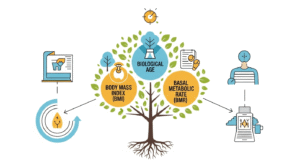
In the quest for health and longevity, understanding the nuances of our body’s functioning is crucial. Three key concepts that often come up in health discussions are biological age, Body Mass Index (BMI), and Basal Metabolic Rate (BMR). While each of these metrics provides unique insights into our health, together they offer a more comprehensive picture of our overall well-being. In this blog post, we’ll explore what biological age, BMI, and BMR are, how they are calculated, and why they matter in the context of health and longevity.

Biological Age: Beyond the Calendar
What is Biological Age?
Biological age refers to the age of our cells and tissues, which may differ from our chronological age (the number of years we’ve been alive). Unlike chronological age, which is a fixed number, biological age can be influenced by various factors such as lifestyle, diet, exercise, and environmental exposures. Essentially, biological age provides a more accurate reflection of our overall health and aging process.
Why is Biological Age Important?
Understanding our biological age can offer valuable insights into our health status and potential longevity. For instance, someone with a biological age lower than their chronological age may be aging more slowly and have a reduced risk of age-related diseases. Conversely, a higher biological age may indicate an increased risk of health issues and a need for lifestyle changes.
Factors Influencing Biological Age
Several factors can influence our biological age, including:
Lifestyle Choices: Smoking, alcohol consumption, and poor diet can accelerate the aging process, while regular exercise and a healthy diet can slow it down.
Stress Levels: Chronic stress can take a toll on our cells and tissues, leading to premature aging.
Sleep Quality: Adequate and restful sleep is essential for cellular repair and regeneration.
Environmental Exposures: Exposure to pollutants, toxins, and UV radiation can damage cells and contribute to aging.
Measuring Biological Age
Various methods and biomarkers are used to estimate biological age, including:
Telomere Length: Telomeres are protective caps at the ends of our chromosomes that shorten as we age. Measuring telomere length can provide insights into cellular aging.
Epigenetic Clocks: These are DNA methylation-based biomarkers that can estimate biological age with high accuracy.
Biomarkers of Aging: Levels of certain proteins, hormones, and other molecules in the blood can indicate the rate of aging.
Body Mass Index (BMI): A Measure of Health
What is BMI?
Body Mass Index (BMI) is a simple and widely used metric to assess body weight relative to height. It is calculated by dividing a person’s weight in kilograms by the square of their height in meters (kg/m²). BMI provides a general indication of whether a person’s weight is within a healthy range.
Why is BMI Important?
BMI is an important tool for identifying potential weight-related health issues. While it is not a diagnostic tool, it can help healthcare professionals assess the risk of conditions such as heart disease, diabetes, and hypertension. BMI is also useful for tracking changes in body weight over time and evaluating the effectiveness of weight management interventions.
Calculating BMI
The formula for calculating BMI is straightforward:
BMI = weight in kilograms / (height in meters)2
Interpreting BMI
BMI values are typically categorized as follows:
Underweight: BMI less than 18.5
Normal weight: BMI between 18.5 and 24.9
Overweight: BMI between 25 and 29.9
Obese: BMI 30 or higher
Limitations of BMI
While BMI is a useful screening tool, it has some limitations. For instance, it does not differentiate between muscle mass and fat mass, which can lead to misclassification in individuals with high muscle mass, such as athletes. Additionally, BMI does not account for the distribution of body fat, which can be an important factor in health risk assessment.
Basal Metabolic Rate (BMR): Fueling the Body
What is BMR?
Basal Metabolic Rate (BMR) represents the number of calories our body needs to perform basic functions at rest, such as breathing, circulation, and cell production. BMR accounts for the largest portion of our daily energy expenditure, typically ranging from 60% to 75% of total calories burned.
Why is BMR Important?
Understanding our BMR is crucial for managing weight and overall health. By knowing our BMR, we can estimate our daily caloric needs and make informed decisions about diet and exercise. For instance, consuming fewer calories than our BMR can lead to weight loss, while consuming more can result in weight gain. Additionally, BMR can provide insights into our metabolic health and potential issues such as thyroid disorders.
Factors Influencing BMR
Several factors can influence our BMR, including:
Age: BMR tends to decrease with age due to changes in body composition and hormonal levels.
Gender: Men typically have a higher BMR than women due to differences in muscle mass and body fat.
Body Composition: Muscle mass is metabolically active and requires more energy to maintain than fat mass. Therefore, individuals with higher muscle mass tend to have a higher BMR.
Genetics: Genetic factors can influence our metabolic rate and how our body processes and stores energy.
Hormonal Levels: Hormones such as thyroid hormones play a significant role in regulating metabolism.
Once we know our BMR, we can estimate our total daily energy expenditure (TDEE) by accounting for physical activity levels. TDEE provides a more accurate estimate of the total calories we burn in a day, which can be useful for weight management. By adjusting our caloric intake based on our TDEE, we can achieve weight loss, maintenance, or gain goals.
The Interconnection of Biological Age, BMI, and BMR
While biological age, BMI, and BMR are distinct concepts, they are interconnected and collectively contribute to our overall health and well-being. For instance, maintaining a healthy BMI through diet and exercise can positively impact our biological age by reducing the risk of age-related diseases. Similarly, understanding our BMR can help us make informed decisions about caloric intake and physical activity, which in turn can influence our BMI and biological age.
Practical Tips for Improving Health and Longevity
Optimizing Biological Age
Adopt a Healthy Lifestyle: Engage in regular physical activity, maintain a balanced diet, and avoid smoking and excessive alcohol consumption.
Manage Stress: Practice stress-reducing techniques such as meditation, yoga, and deep breathing exercises.
Prioritize Sleep: Aim for 7-9 hours of quality sleep per night to support cellular repair and regeneration.
Minimize Environmental Exposures: Reduce exposure to pollutants, toxins, and UV radiation by using protective gear and choosing clean, non-toxic products.
Maintaining a Healthy BMI
Balanced Diet: Focus on consuming a variety of nutrient-dense foods, including fruits, vegetables, whole grains, lean proteins, and healthy fats.
Regular Exercise: Engage in a mix of cardiovascular, strength training, and flexibility exercises to support overall health and weight management.
Monitor Portion Sizes: Be mindful of portion sizes to avoid overeating and maintain a healthy weight.
Stay Hydrated: Drink plenty of water throughout the day to support metabolism and overall health.
Supporting a Healthy BMR
Build Muscle Mass: Incorporate strength training exercises into your routine to increase muscle mass and boost BMR.
Eat Regularly: Consume balanced meals and snacks throughout the day to keep your metabolism active.
Stay Active: Engage in regular physical activity to support metabolic health and overall well-being.
Get Enough Sleep: Prioritize quality sleep to support hormonal balance and metabolic function.
Conclusion
Understanding biological age, BMI, and BMR is essential for taking control of our health and longevity. By adopting a holistic approach that addresses lifestyle, diet, exercise, and environmental factors, we can optimize these metrics and improve our overall well-being. Remember, the journey to health and longevity is a marathon, not a sprint. By making small, sustainable changes, we can achieve lasting results and enjoy a healthier, more vibrant life.