

The longevity industry is built on what works for 25-year-old men.
Cold plunges. High-intensity sprints. Fasting for 24 hours. Aggressive strength training. It’s all optimized for people with stable hormones, zero menstrual cycle disruption, and bodies that recover like they’re bouncing.
Women over 40 get the same advice, adjusted down by 20%. Do 80% of the man’s workout. Fast for 14 hours instead of 18. Take it easier.
That’s not science. That’s laziness.
The truth is your body after 40 responds differently to the same interventions. Not worse—differently. Estrogen decline changes how you recover. Progesterone shifts your circadian rhythm. Your mitochondria age faster in some tissues, slower in others. Your bone density becomes a priority in ways it wasn’t at 30.
The protocols that actually move your biological age markers aren’t the ones you see on Instagram. They’re unsexy. They require patience. And almost nobody talks about them because they don’t sell supplements or $15,000 devices.
Here’s what the research actually shows about aging well as a woman over 40.
The Estrogen Problem (And Why It Matters More Than Anyone Admits)


At 40, your estrogen is dropping. At 50, if you’re perimenopausal or menopausal, it drops hard. This isn’t a cosmetic issue. It’s a biological clock issue.
Estrogen regulates mitochondrial function. It’s a potent antioxidant. It protects your cardiovascular system. It keeps your bone density stable. When it declines, all of those systems age faster.
According to research from the Mayo Clinic, women’s biological aging accelerates by roughly 10-15% during the perimenopausal years (typically ages 40-55). Not because you’re doing anything wrong. Because your hormones shifted.
This is why the standard longevity protocols fail women over 40. They’re designed for people whose estrogen isn’t declining. When your estrogen is dropping, your recovery slows. Your mitochondrial function dips. Your tolerance for extreme stress (ice baths, 24-hour fasts, brutal HIIT) decreases.
The response from most longevity coaches is to tell you to push harder. More fasting. Colder cold plunges. Harder workouts.
That’s backwards. You need to shift the protocol entirely.
What Changes (And What Doesn’t)
Some interventions for longevity are genuinely universal. Sleep is universal. Movement is universal. Avoiding chronic stress is universal.
Some interventions need to be recalibrated.
High-intensity exercise. This is where the sex difference is real. Research from the Journal of Applied Physiology shows that women show the same mitochondrial gains from HIIT as men—but recovery takes longer. A man might do HIIT 3 times per week with full recovery. A woman over 40 gets better results from HIIT 2 times per week with stronger emphasis on recovery days.
It’s not weakness. It’s hormonal reality. Lower estrogen means lower capacity for anabolic stress without triggering cortisol dysregulation.
Fasting. Here’s where bro science really fails. A study in Nutrients journal found that extended fasting (18+ hours) in women with lower estrogen can dysregulate cortisol and actually slow fat loss. The same fasting protocol that works for men produces cortisol elevation, which ages you.
Women over 40 typically see better results with 12-14 hour fasts rather than 18-hour ones. Same metabolic benefits. Better hormonal tolerance.
Cold exposure. Cold plunges work for everyone. But the dose matters differently. Research from Karolinska Institute showed cold exposure increases norepinephrine and brown fat activation in both sexes. But in women with lower estrogen, very aggressive cold (sub-50°F for 5+ minutes) can trigger excessive cortisol response without the same mitochondrial gains.
Women over 40 get equivalent benefits from shorter, less extreme cold exposure: 60-second cold showers or 2-minute ice baths at 55°F rather than 3-minute plunges at 40°F.
Heat therapy (sauna). Here’s where things get interesting. Heat actually improves with age in women. Sauna hits cardiovascular markers harder in women over 40 than in younger women. A study in JAMA Internal Medicine found that regular sauna use (4-7 times per week) was associated with a 40% reduction in sudden cardiac mortality in both sexes, but the benefit started showing up earlier in perimenopausal women.
Do more sauna, not less. 20-30 minutes, 4-5 times per week is ideal.
Strength training. This is the one where women over 40 need to do more than men, not less. Research from Tufts University shows that muscle loss accelerates in women after 40 at roughly 8% per decade if sedentary, compared to 3-5% in men. But the response to resistance training is actually superior in women over 40 when estrogen is lower.
Why? Lower estrogen means less inhibition of myostatin (a protein that limits muscle growth). Women over 40 can build muscle nearly as efficiently as younger women if they train consistently.
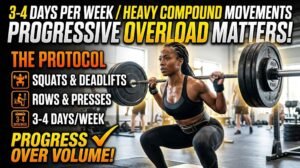
The protocol: 3-4 sessions per week of resistance training, emphasis on heavy compound movements (squats, deadlifts, rows, presses). Progressive overload matters more than volume.
The Metabolic Reality After 40
Your metabolism doesn’t slow as much as people think. According to the NIH, resting metabolic rate declines by roughly 2-3% per decade after 30. But that’s in sedentary people.
What actually changes is insulin sensitivity and mitochondrial efficiency.
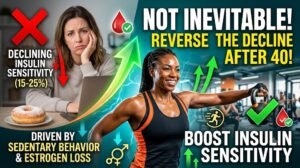
At 40, insulin sensitivity typically declines 15-25% compared to age 25. This isn’t inevitable. It’s mostly driven by sedentary behavior and estrogen loss. But it’s real.
The consequence: the fasting and cardio approach that worked at 30 stops working as well. You don’t burn fat as easily on the same protocol.
The fix isn’t to eat less. It’s to improve insulin sensitivity directly through two interventions:
Resistance training first thing after waking. A study in the Journal of Applied Physiology found that resistance exercise performed in the fasted state (after waking, before eating) produced superior insulin sensitivity improvements in women over 40 compared to fed-state exercise or cardio.
You don’t need to be perfect. 20-30 minutes of resistance training in a fasted state (after water and coffee, before breakfast) produces measurable insulin sensitivity gains in 4-6 weeks.
Protein timing and distribution. Women over 40 need more total protein than younger women and need to distribute it across the day differently. Research from McMaster University shows that women over 40 need roughly 1.6-2.0g of protein per kg of body weight daily (compared to 1.2g for younger women) to maintain muscle mass with adequate training.
More importantly, protein distribution matters. Three meals at 20g protein each is inferior to four meals at 25-30g protein each for women over 40. The reason: muscle protein synthesis (the process of building and maintaining muscle) is triggered by threshold protein intake per meal, and that threshold increases slightly with age.
Practical example: a 150-pound woman needs roughly 110-135g protein daily (0.75 to 0.9g per pound). Spread across 4-5 meals instead of 3. That’s 25-30g per meal.
Sleep Architecture Changes
Everyone says sleep matters. Women over 40 need to know that the architecture of sleep changes.
Estrogen decline typically reduces deep sleep (stages 3-4, also called slow-wave sleep). This is the sleep stage where your brain clears metabolic waste, your glymphatic system activates, and your mitochondria repair.
You might be sleeping 8 hours and only getting 20% deep sleep instead of the 15-20% you had at 30.
Research from UC Berkeley’s Matthew Walker shows that the interventions that improve deep sleep in women over 40 are different from younger women:
Temperature control matters more. Your core body temperature naturally dips less at night with lower estrogen. A cool sleeping environment (60-67°F) becomes critical rather than optional.
Consistency is non-negotiable. Irregular sleep schedules damage deep sleep architecture in women over 40 more than in younger people. A consistent bedtime and wake time (even on weekends) produces measurably more deep sleep than variable schedules.
Magnesium glycinate before bed works. A study in Magnesium Research found that magnesium glycinate (not other forms) at 300-400mg taken 30-60 minutes before bed increased deep sleep duration by roughly 20 minutes per night in women over 40. The effect wasn’t as pronounced in younger women.
Alcohol is worse than you think. Alcohol suppresses REM and deep sleep in everyone, but the effect is more severe in women over 40. Two drinks reduce deep sleep by 30-40% in women over 40, compared to 20-25% in younger women.
Bone Density: The Urgent Marker Nobody Talks About

Here’s the unsexy truth: bone density matters more for longevity than biological age clocks.
A woman’s bone density peaks around age 30. By 40, it’s stable but declining slowly. By 50, if you’re menopausal or perimenopausal, it can drop 1-2% per year.
The WHO defines osteoporosis as a bone density T-score below -2.5. Most women reach that threshold by age 70-75 if they don’t intervene. That threshold correlates strongly with lifespan—fracture risk after 70 is one of the strongest predictors of mortality.
But here’s the thing: bone density is nearly perfectly predictable and preventable. It’s not genetic. It’s mechanical.
Bones respond to load. When you stress bone tissue, osteoblasts (bone-building cells) activate and rebuild bone denser. When you don’t stress bone, osteoclasts (bone-breaking-down cells) win.
The protocol for bone density after 40:
Resistance training with heavy loads. You don’t need to be a powerlifter. You need to lift heavy enough that your muscles strain. Research from the Journal of Bone and Mineral Research shows that resistance training with loads of 70%+ of your 1-rep max triggers bone adaptation. Lighter loads (50% 1RM) don’t.
Practical: if you can squat 150 pounds for 1 rep, training at 105+ pounds (70% of 1RM) triggers bone adaptation. Machines, barbells, or weighted vests—any load that stresses your skeleton works.
Impact activity. Walking is not enough. You need impact. Jumping, sprinting, hiking on uneven terrain. Studies in the Journal of Applied Physiology show that impact activities (jumping, stairs, trail running) build bone density faster than walking.
You don’t need to do this often. Twice per week of either resistance training with heavy loads or impact activity maintains bone density. Three times per week reverses decline.
Vitamin D and K2. Bone building requires both. Most women over 40 are deficient in one or both.
Vitamin D: aim for serum levels of 40-60 ng/mL. Most people need 2,000-4,000 IU daily from supplementation plus sun exposure.
Vitamin K2: roughly 90-120 mcg per day. Food sources include fermented dairy (natto), grass-fed butter, and some cheeses. Most supplements don’t have enough.
Adequate calcium. Not the conversation starter it was 20 years ago, but still necessary. 1,000-1,200mg daily from food. Dairy, leafy greens, fortified plant milks, or supplements if needed.
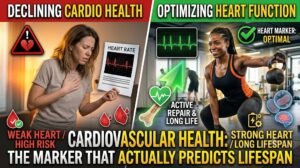
Cardiovascular Health: The Marker That Actually Predicts Lifespan
Biological age clocks are fun to measure. Your biological age according to epigenetic tests is interesting.
But what actually predicts whether you’ll be alive at 85 is your cardiovascular system.
VO2 max (your maximum oxygen uptake) is one of the strongest predictors of lifespan. Every 3.5 ml/kg/min increase in VO2 max correlates with roughly 15% improvement in life expectancy.
Women over 40 have lower VO2 max than men on average (roughly 25-35 ml/kg/min vs. 35-50 in men), but the good news is that VO2 max responds to training faster in women over 40 than in any other demographic.
Why? Starting from a lower baseline, the adaptation is more dramatic. A woman with VO2 max of 28 who trains hard can increase to 35 in 12 weeks. That’s a 25% improvement, which translates to roughly 25-30% mortality improvement.
The protocol:
HIIT 2 times per week. High-intensity interval training improves VO2 max faster than any other modality. 20-30 minutes total, with 3-5 minute warm-up, then 30-90 second high-intensity intervals alternated with 60-120 second recovery intervals.
One session can be on a bike, rowing machine, or running. The other should be different (different muscle groups, different equipment).
Zone 2 cardio 1-2 times per week. This is moderate-intensity, conversational-pace aerobic exercise. 30-45 minutes at a heart rate where you could talk but not sing. Running, cycling, swimming, hiking.
Zone 2 isn’t sexy, but it builds mitochondrial capacity and aerobic base that makes HIIT more effective.
Hormonal Support: When to Consider It
This is where I need to be direct: menopause is not a disease, but it’s also not something to white-knuckle through.
Estrogen loss is real. It accelerates aging. The question is how to address it.
Hormone therapy considerations: Estrogen replacement therapy has legitimate benefits for women over 40, especially in the perimenopausal and early menopausal years. Research from the Women’s Health Initiative and subsequent studies have shown that HRT started within 10 years of menopause onset is associated with cardiovascular benefits and cognitive protection, with lower absolute risk than initially thought.
The decision is personal and medical. Talk to a doctor who specializes in menopause (not just general practitioners). If you pursue HRT, the evidence supports bioidentical forms, transdermal delivery (patch, cream), and the lowest effective dose.
If HRT isn’t right for you, there are evidence-backed alternatives.
Phytoestrogens: Compounds in plants that weakly activate estrogen receptors. Red clover, sage, and soy have the strongest evidence. They won’t replace estrogen, but they reduce hot flashes and support bone density in some women. Effects are modest but measurable.
Resistance training: This is the non-hormonal estrogen replacement. Resistance training activates similar signaling pathways that estrogen activates, improves mitochondrial function, and protects bone and muscle. The effect is real but requires consistency.
The honest take: if you’re struggling with hot flashes, brain fog, or rapid aging markers, HRT has legitimate benefits. If you want to avoid it, resistance training + sauna + sleep + protein + bone-loading work gets you most of the way there, just slower.
What to Actually Track
Biological age clocks are fun. But they’re not predictive in the way that physical markers are.
Track these instead:
VO2 max. Test it once per year. Most fitness watches estimate it. Get a lab test once every 2-3 years to validate the watch estimate. Target: 30+ ml/kg/min. Increase of 1-2 points per year is sustainable progress.
Resting heart rate. Measure first thing in the morning before getting out of bed. Target: below 60 bpm. Improvement of 2-3 bpm over a few months indicates cardiovascular adaptation.
Fasting insulin. One blood test per year. Target: below 8 mIU/L. This is a better marker of metabolic health than fasting glucose.
Bone density. DEXA scan every 2 years if you’re over 45. Track T-score. Even a stable T-score is a win (decline is the default without intervention). Improvement is rare but possible with aggressive training.
Grip strength. Simple. Cheap. Free gym equipment or a grip dynamometer. Measure dominant hand, take best of 3 attempts. Target: maintain or improve year over year. Decline in grip strength predicts mortality better than most biomarkers.
Body composition. Not weight. Muscle mass and visceral fat. Get a DEXA scan or InBody scan annually. Target: maintain or gain muscle, maintain or lose visceral fat.
The Unsexy Reality
The stuff that actually works for women over 40 isn’t exciting.
Consistent resistance training. Regular sauna. 8 hours of sleep. 4-5 meals with 25-30g protein each. Walking for recovery. Moderate fasting (12-14 hours, not 18-24). Controlled cold exposure. Strength and bone-loading work.
It doesn’t require expensive devices. It doesn’t require extreme protocols. It doesn’t photograph well.
But the data is clear: women over 40 who do these things age slower than women who do the “advanced” protocols designed for 25-year-old men.
The difference isn’t dramatic month to month. It’s decisive over 5-10 years.
At 45, you can be the biological age of 38 or 52. The difference is mostly the consistency of these boring interventions, not the sophistication of the protocol.
FAQ
Should I do HRT or not?
That’s a personal medical decision, not a longevity decision. The evidence supports HRT in the perimenopausal years if you’re struggling with symptoms and you’re within 10 years of menopause onset. If you’re not struggling or you’re further out from menopause, aggressive training + other interventions gets you most of the way there. Work with a doctor specializing in menopause medicine, not a general practitioner.
How much HIIT is too much?
Twice per week is optimal for VO2 max and mitochondrial gains. More than 3 times per week in women over 40 typically increases injury risk without additional benefit. Recovery matters more than frequency.
What if I hate cold plunges?
Don’t do them. Cold showers at 60°F for 30-60 seconds produce most of the same benefits. Or just skip them entirely. The marginal gain from cold exposure is real but modest. Sauna, sleep, and training matter more.
Can I reverse bone loss or is it too late?
Reversing advanced osteoporosis is hard. Preventing further decline and rebuilding some density is very possible with aggressive resistance training (70%+ 1RM loads) + impact activity + adequate protein + vitamin D/K2. DEXA scans show measurable improvement in 12-18 months with consistent effort.
How do I know if my protocol is working?
Measure VO2 max annually. Check resting heart rate monthly. Get fasting insulin tested yearly. Do DEXA scan every 2 years. Track grip strength quarterly. If VO2 max is stable or improving, resting heart rate is stable or dropping, fasting insulin is stable or improving, and bone density is stable or improving, your protocol is working. Everything else (how you feel, energy levels, appearance) is secondary to these markers.
Is it too late to start at 50?
No. Research shows that women in their 50s and beyond show robust improvements in VO2 max, bone density, muscle mass, and metabolic markers with consistent training. The gains are slightly slower than starting at 40, but the trend is identical. Start now.
The Bottom Line
The longevity advice women over 40 need is not a lesser version of what men need. It’s a different version.
You have different hormonal reality. Your body recovers differently. Your priorities are different (bone density, cardiovascular health, muscle preservation matter more than they do at 25).
The protocols that work are boring: resistance training, sauna, sleep, adequate protein, controlled fasting, measured cardio. Not extreme. Not trendy. Consistent.
But they work. The data is clear. Women who follow these protocols age slower. They’re stronger at 60 than sedentary women at 40. They maintain independence, mobility, and cognitive function into their 80s.
That’s not exciting. But it’s real.
Want to measure your biological age across all 8 pillars? The Reverse Age Coaching Program tracks women over 40 across VO2 max, HRV, body composition, metabolic markers, and the 8-Intelligence Framework specifically calibrated for perimenopausal and menopausal women. Get your baseline assessment here.