


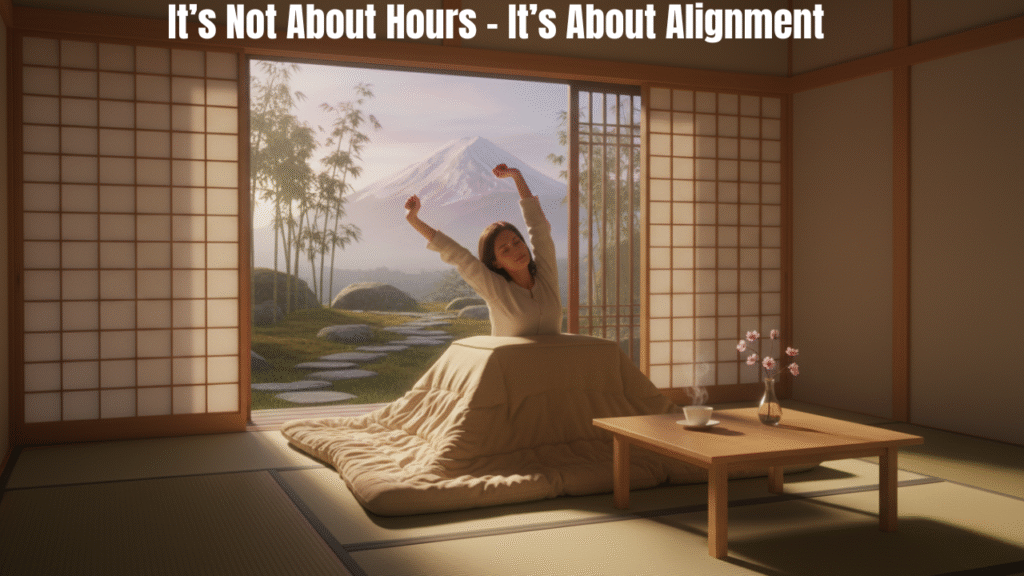
🌅 Introduction: The Paradox of Less Sleep, More Life
Since childhood, we’ve been told that 8 hours of sleep is sacred. Anything less, and we risk burnout or disease.
Yet Japan—where adults average just 6 to 6.5 hours of sleep per night—boasts the highest life expectancy in the world: 87.1 years for women and 81.1 for men (World Health Organization, 2025). Even more impressively, Japan’s obesity rate is only 4–6%, compared to over 40% in the U.S.
How do they manage this paradox?
The answer lies not in luck or genes, but in energy intelligence, lifestyle rhythm, and cultural alignment with nature’s cycles.
As a Reverse Age Coach, I help busy professionals apply these same principles to reduce their biological age by 5–10 years, reignite their energy, and rediscover a youthful glow—without needing to “sleep more” or “work less.”
🖼️ Image Prompt – Introduction
A serene early morning scene in Tokyo: soft sunlight through shoji screens, a person waking up on a tatami mat, stretching calmly. A cup of green tea and a clock show 6:00 a.m. Minimalist, cinematic, warm tones, symbolizing peaceful energy and balance.
🕰️ Section 1: Sleep Quality Over Quantity – The Science Behind It
Western science often frames sleep as purely quantitative. Yet studies show that sleep efficiency, depth, and circadian regularity have stronger impacts on health outcomes than total hours slept.
📚 Evidence:
The National Sleep Foundation (2023) found that individuals with higher deep-sleep percentages performed better on cognitive and metabolic tests—even with less than 7 hours of sleep.
A Japanese cohort study (PMC7813766) confirmed that overly long sleep (>8 hours) correlates with increased all-cause mortality—suggesting a U-shaped relationship between sleep duration and lifespan.
In Japan, the emphasis is on consistency and depth, not duration. Pre-sleep rituals, aligned meal timing, and rhythmic lifestyles support faster entry into non-REM restorative cycles, protecting mitochondrial and hormonal health.
🖼️ Image Prompt – Sleep Quality
A close-up of a Japanese futon on tatami mat under golden dawn light, neatly arranged. A low wooden table with green tea, a simple alarm clock, and a calm aesthetic. Symbol of order and mindfulness.
🌿 Section 2: The Cultural Rhythms That Guard Circadian Health
The Japanese naturally align with circadian biology through three daily anchors: movement, meals, and light exposure.
Movement: Walking, cycling, and public transit are cultural norms, maintaining insulin sensitivity and active mitochondria (Lopez-Otin et al., Cell, 2013).
Meals: Structured, moderate, and rarely rushed—rich in omega-3s, fermented foods, and green tea. These support gut microbiota, lower inflammation, and enhance sleep hormones like melatonin.
Light: Natural light exposure early in the day stabilizes circadian clocks, enhancing nighttime melatonin release.
Even their nap culture (inemuri) is biologically strategic. A UCL 2023 study found that 20–30 minute naps preserve brain volume and delay cognitive aging by up to six years.
🖼️ Image Prompt – Cultural Rhythms
Street-level view of Tokyo in the morning: people cycling or walking, a small breakfast café, warm natural light. The composition conveys active yet calm urban balance.
💧 Section 3: Environment and Design – The Hidden Sleep Architecture
The physical environment in Japanese homes supports deep rest:
Futons and tatami mats promote spinal alignment and reduce micro-awakenings.
Cool bedroom temperatures (15–18 °C) enhance thermoregulation and deep sleep.
Pre-bed baths trigger parasympathetic activation, promoting calm.
Westerners call this “biohacking.” In Japan, it’s called tradition.
🖼️ Image Prompt – Environment
Warm minimalist Japanese bedroom, neutral colors, futon neatly folded, wooden textures, soft indirect lighting, small bonsai plant. Cinematic realism, 8K detail.
⚙️ Section 4: What Western Sleep Science Is Missing
In the West, sleep deprivation often stems not from less sleep but from lifestyle fragmentation—late meals, screen light, erratic schedules, and sedentary days.
The Japanese model reminds us that:
Sleep is an outcome, not an isolated habit.
Routine and alignment—not just sleep hours—determine biological recovery.
Cultural harmony reduces cortisol and supports mitochondrial longevity.
When you synchronize body, behavior, and environment, even six hours of efficient sleep can rejuvenate like eight.
🖼️ Image Prompt – Western Comparison
Split-image concept: left half shows chaotic modern bedroom with blue screens, clutter, coffee cups; right half shows serene Japanese-style room. Contrast between chaos and calm.
🔬 Section 5: Applying the Japanese Sleep Model to Reverse Aging
As a Reverse Age Coach, my framework integrates these Japanese insights into Energy Intelligence—a system I use to help busy professionals rejuvenate cellularly.
The 4 Dimensions of Energy Intelligence:
Physical Energy – restore mitochondrial vitality through movement, nutrition, and sleep optimization.
Mental Energy – enhance focus via circadian work blocks and recovery cycles.
Emotional Energy – manage stress and mood to reduce cortisol-linked aging.
Relational Energy – build environments and connections that energize rather than drain.
With structured coaching, professionals learn to:
✅ Wake up energized and focused
✅ Reverse visible signs of aging
✅ Lower biological age markers (e.g., HRV, telomere length, inflammation)
✅ Sustain peak productivity without burnout
🖼️ Image Prompt – Coaching
A confident professional (mid-30s) working in a bright minimalist office, standing beside a Reverse Age Coach explaining metrics on a tablet: heart rate variability, biological age dashboard, sleep score. Tone: empowering, modern, scientific.
🌸 Section 6: Start Your Reverse Aging Journey
If you’re constantly tired despite “doing everything right,” you don’t need another supplement or gadget—you need a smarter energy system.
As your Reverse Age Coach, I’ll help you:
Identify hidden age accelerators (stress, circadian disruption, sleep inefficiency).
Build a 30-day personalized Sleep-Longevity Blueprint based on your lifestyle.
Integrate natural recovery habits inspired by Japan’s rhythm of life.
You’ll look younger, feel sharper, and move with the vitality of someone 10 years younger.
👉 Book your free Reverse Age Discovery Call
🖼️ Image Prompt – Call to Action
A sunrise reflecting over Tokyo skyline, symbolizing renewal and energy. In the foreground, a professional smiling confidently while stretching arms to the light. Caption overlay: “Reverse Your Biological Age—Start Today.”
🧘♂️ Conclusion
The Japanese aren’t defying biology—they’re living in alignment with it.
Their secret isn’t sleeping less; it’s sleeping smarter. When behavior, biology, and belief merge into rhythm, recovery becomes effortless—and even 6 hours can feel like 8.
For busy professionals striving for longevity and vitality, this is your wake-up call:
It’s not time that ages you—it’s misalignment.
Align your rhythm, master your energy intelligence, and let your body’s natural intelligence do the rest.